The Pools payments in the UK: deposits, entry payments and payout routes
 Available in GB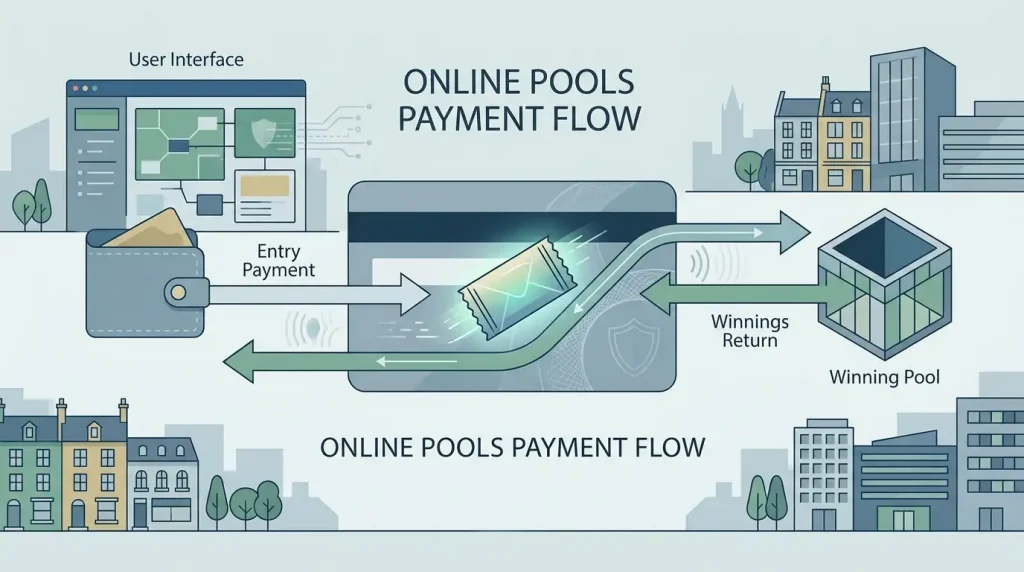
The Pools’ current 2026 product is centred on Jackpot games rather than the former Sports and Casino services. Current brand replies state that players register, choose a Jackpot game and can enter through a subscription or pay-to-play route, with winnings returned to the payment method used for the entry. That is the most useful starting point for understanding The Pools payments today.
The exact current list of supported cards, wallets, minimum entry payments, fees and failed-payment rules is not published here because the accessible evidence does not establish a complete live method list to the standard required for this guide. One rule is clear across Great Britain: licensed gambling businesses cannot accept credit-card payments for gambling, including through e-wallet arrangements that allow credit-card-funded gambling. Check the live checkout before committing money.
Table of Contents
- What is actually confirmed about The Pools payments?
- Entry payment and payout destination are linked
- Credit cards cannot be used for gambling in Great Britain
- Debit cards are common in the UK market, but that is not proof of brand support
- Subscription versus pay-to-play changes the payment decision
- What to verify on the live payment screen
- Why an expired or replaced card can matter
- Account checks and payments are connected, but not the same topic
- Financial limits are part of the UK payment context
- Common payment-search mistakes to avoid
- Bottom line
What is actually confirmed about The Pools payments?
The strongest current brand-level payment fact is qualitative rather than a long logo list. The Pools has explained in 2026 business replies that its present Jackpot products do not require the same withdrawal-request process associated with the former Sports and Casino products. Instead, Jackpot winnings are paid back to the payment method used to enter.
That description matters because it changes the usual way people search for “casino deposits” and “withdrawals”. The Pools is not currently offering its old casino or sportsbook. Readers arriving from historic reviews may still see references to wallet deposits, sports balances, casino cashier pages or old withdrawal tests. Those details belong to an earlier product set and should not automatically be treated as the current Jackpot payment experience.
What this guide does not infer is equally important. Older branded payment material exists inside a legacy service environment that also contains discontinued product navigation. It is therefore not safe to treat historic payment material as a complete current method list for 2026 Jackpot entries.
Entry payment and payout destination are linked
For the current Jackpot model, think in terms of an entry payment first and a payout route second. If you enter one of the current products and win, the brand’s current explanation is that the winnings go back to the method used for that entry. This differs from a conventional gambling wallet where you deposit into an account balance, play across multiple products and later request a separate withdrawal.
The distinction is useful when comparing The Pools with a standard sportsbook or online casino. It also helps explain why an old search result for The Pools withdrawal can be misleading: some historic complaints and guides concern Sports or Casino balances, cards that later expired, or the process of removing funds after those products were withdrawn from the site.
The direct-return description does not establish an exact processing time. It also does not establish whether every possible payment route is treated identically, whether a failed return triggers a manual process, or whether fees or limits apply in a particular edge case. Those are the kinds of details that need a current official terms or payments page before they should be quoted as precise facts.
Credit cards cannot be used for gambling in Great Britain
The most important UK-wide payment rule is the Gambling Commission’s credit-card prohibition. Licence condition 6.1.2 says licensees must not accept payment for gambling by credit card. The rule also covers payments made through a money service business, so an operator cannot treat an e-wallet as a simple workaround if the wallet allows credit-card funds to be used for gambling.
The Commission’s public guidance makes the practical effect clear: gambling businesses should reject wallet routes that do not block credit-card funds for gambling. This applies broadly across remote licensed gambling. The rule is therefore a regulatory boundary on The Pools payment journey even though it does not tell us which non-credit methods the site currently displays.
If a payment screen asks for a card, do not assume the presence of a card form means every card type is accepted. A debit card and a credit card may share familiar network branding, but the gambling rule turns on the source of funds and card type rather than the visual logo alone.
The primary regulatory basis can be checked on the Gambling Commission’s credit-card licence condition and its e-wallet guidance.
Debit cards are common in the UK market, but that is not proof of brand support
Gambling Commission research has found that debit cards account for the vast majority of remote gambling deposits in Great Britain, while major e-wallets are also widely used in the market. That is useful context for understanding how UK players typically fund remote gambling, but it must not be converted into a statement that The Pools supports every widely used debit card or wallet.
This source separation is especially important here because older The Pools pages contain payment logos that may no longer describe the current Jackpot checkout. Market prevalence answers one question – what UK remote gamblers commonly use – while a live The Pools payment screen answers another – what the brand accepts for a particular entry today.
If you specifically need to know whether a named wallet, bank card or digital payment service works, the safest sequence is to sign in, open the live entry journey for the game you intend to play, and review the payment choices before confirming. Do not rely on a search snippet that may have indexed the legacy sportsbook or casino cashier.
Subscription versus pay-to-play changes the payment decision
Current brand guidance says Jackpot games can be played through subscription or by choosing a pay-to-play option. The payment question is therefore not only “which method can I use?” but also “what kind of commitment am I authorising?” A one-off entry and a recurring subscription can have very different budgeting implications even when the same underlying payment instrument is used.
Before selecting a subscription, verify the live amount, billing frequency, renewal behaviour and cancellation route. Those are current commercial terms and should be read where they are presented during the active journey. If you prefer occasional participation, a recurring method may be less suitable even if it is convenient.
Before pay-to-play, confirm the amount shown for that entry and whether any optional extras or multiple lines have changed the total. The general principle is simple: decide your entertainment budget first, then select an entry type that fits inside it. Do not increase spend because a jackpot headline looks unusually large.
For how the games differ before you reach payment, see the Classic Pools guide and the broader current games overview.
What to verify on the live payment screen
A payment page is the right place to answer details that can change faster than an editorial guide. Use this checklist before authorising an entry:
- Method: confirm the exact card, bank or wallet option shown for your account and chosen game.
- Amount: check the total price of the entry or subscription before confirming.
- Recurring status: identify whether the payment is one-off or creates an ongoing subscription.
- Ownership: check any requirement that the payment instrument belongs to the registered account holder.
- Authentication: complete any bank or payment-provider verification requested during checkout.
- Return route: note that current Jackpot winnings are described as returning to the payment method used to enter.
- Card expiry: if you expect the card to expire soon, consider how a later return would be handled and check current support guidance.
- Fees and minimums: rely on the amount displayed in the live flow rather than an old review.
This is also the point to stop if the live information does not match what you expected. A current checkout has greater decision value than a static payment-method list copied from a historic service page.
Why an expired or replaced card can matter
The Pools’ 2026 public replies make a useful distinction between current Jackpot payouts and historic issues involving the former Sports and Casino products. The brand has acknowledged that some earlier withdrawal problems involved payments being returned to old or expired cards. That does not prove a specific current failed-payment procedure, but it shows why keeping payment details current can matter.
If the payment method originally used is no longer active, do not assume that the money will simply be redirected automatically to a new card or wallet. Payment systems can have issuer-level mechanisms for replacement cards, but an editorial guide should not predict how a particular case will be routed without current operator terms. Contact player support if the destination method has changed materially.
For the separate question of what happens when a payout has not arrived, use the dedicated payout and withdrawal guide. That page focuses on troubleshooting without importing old sportsbook or casino processing-time claims.
Account checks and payments are connected, but not the same topic
Licensed gambling operators may need to carry out age, identity, financial-risk or account-security checks. A payment may therefore be affected by the status of the account even when the payment instrument itself is valid. This guide does not publish an exact The Pools KYC document list or processing time because those are high-risk details that require a current official source.
If the site asks you to complete an account check, follow the instructions shown in the secure account area rather than uploading documents anywhere else. The separate The Pools account guide covers registration and verification boundaries in more detail.
The practical distinction is useful: payment support answers questions about the transaction route, while account verification answers questions about whether the operator can lawfully and securely maintain or pay the account. A problem can involve one, the other, or both.
Financial limits are part of the UK payment context
Great Britain’s remote gambling framework is also tightening the way financial limits are presented. Updated Gambling Commission technical standards take effect on 30 September 2026, requiring customers to be given accessible facilities to set financial limits and prompting them to set a limit during registration or at the first deposit or payment.
As of 28 September 2026, the implementation date is still two days away. The practical lesson does not depend on waiting for the rule: choose a spending ceiling before making an entry. A limit should reflect money you can comfortably treat as entertainment expenditure, not the amount you hope to win back.
Do not confuse a personal limit with an operator’s minimum entry price. One is a control you set around your own spending; the other is a commercial term of the game. The live payment flow is where you should verify the latter.
Common payment-search mistakes to avoid
- “I found PayPal on an old The Pools page, so it must be current.”
- Not necessarily. The legacy page is evidence of historic support, not proof of the complete 2026 Jackpot method set.
- “Debit cards dominate UK gambling, so every debit card must work.”
- No. Market prevalence does not establish brand-level acceptance, issuer restrictions or account eligibility.
- “A payout goes back to my entry method, so it must be instant.”
- No. The route is not the same thing as a guaranteed processing time.
- “An e-wallet lets me use a credit card elsewhere, so I can fund gambling that way.”
- Great Britain rules require gambling operators to prevent credit-card gambling through e-wallet routes as well.
- “The old casino cashier explains today’s Jackpot payment model.”
- The former Casino and Sports products were removed in 2026, so their cashier workflow should not be used as the default description of the current service.
Bottom line
The useful current picture is narrower than many old payment reviews suggest. The Pools now focuses on Jackpot games, offers subscription and pay-to-play entry routes, and has stated that winnings from those games are returned to the payment method used to enter. Great Britain rules prohibit credit-card gambling, including indirect credit-card use through e-wallets.
What this page intentionally does not provide is a supposedly complete 2026 list of supported payment brands, exact fees, minimums, payout times or failure rules. Those details need the current live payment surface or official terms. If your main question is how a win is returned or what to do when money has not arrived, continue to the The Pools payouts and withdrawals guide. For the overall product reset and licence context, return to the The Pools UK review or read the The Pools licence and trust. If you plan to make entries on a phone or tablet, the The Pools mobile guide covers browser access and device considerations.