The Pools account guide: registration, verification and safer limits
 Available in GB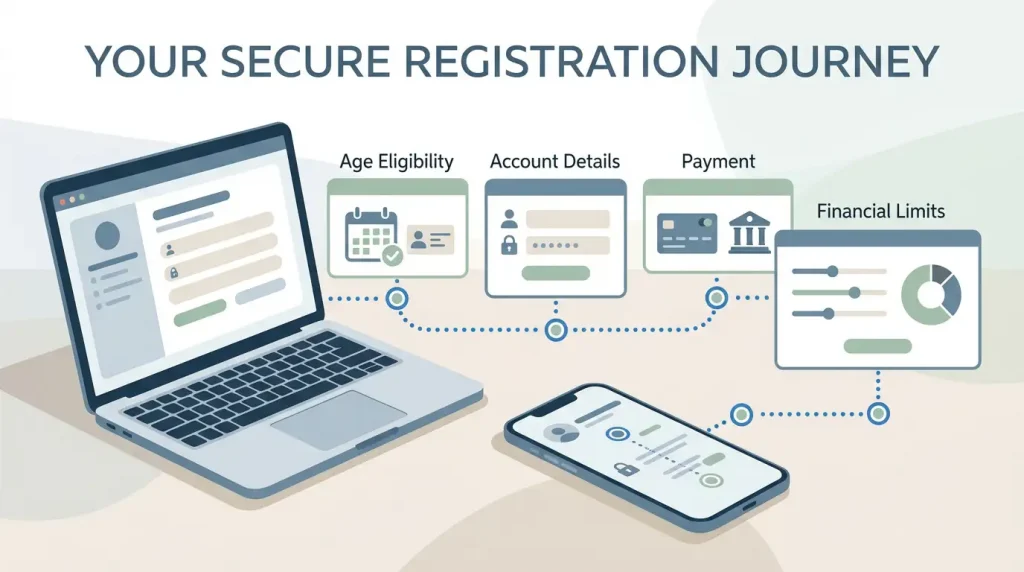
The Pools still allows UK users to register for its current Jackpot products in 2026. The present journey is no longer built around the former Sports and Casino services: after creating or signing into an account, players choose among the current Jackpot products and can enter by subscription or pay-to-play. This guide focuses on that current account model rather than recycling old casino sign-up instructions.
Verification can still form part of a gambling account journey, but this page does not publish a fixed KYC document list or promise a processing time because those exact requirements need current official sourcing. A separate UK-wide rule is clearer: remote operators must make financial-limit tools accessible from registration and prompt customers to consider a limit during registration or at the first deposit or payment. Further terminology changes take effect on 30 September 2026.
Table of Contents
- What registration means on The Pools in 2026
- A practical sign-up sequence
- What verification can involve – and what this guide will not invent
- Financial limits are part of the account journey
- What changes on 30 September 2026
- Subscription and pay-to-play need different checks
- Payment ownership and account consistency
- Safer gambling and self-exclusion
- Legacy Sports and Casino balances are a separate issue
- Account setup checklist
- Bottom line
What registration means on The Pools in 2026
The key first step is to separate current registration from the product range that disappeared earlier in 2026. The Pools remains active, but the Sports and Casino products were removed and the brand’s public replies now direct customers toward its Jackpot games. That means an old review showing sportsbook markets, slot lobbies or a casino welcome journey is not a reliable account guide for the service that exists now.
Current brand guidance says users can register and then choose a Jackpot game, with subscription and pay-to-play available as entry routes. The account therefore functions as the identity and access layer for the current games rather than as evidence that every historic product remains available. Before registering, decide whether the current games are actually what you want to use the account for. That check can prevent an unnecessary account opening based on an outdated review.
If your purpose is to compare the active games first, read the The Pools games overview. That is a better starting point than opening an account on the assumption that the old Sports or Casino catalogue is still there.
A practical sign-up sequence
A sensible current registration journey is straightforward at a high level: open the official website, choose the registration route, provide the information requested in the live form, create secure sign-in details, and then review the account and payment prompts shown before entering a game. The exact fields can change, so this guide does not hard-code a form that may become outdated.
Use details that belong to you and that you can continue to access. That matters because account recovery, payment ownership checks and any later verification all depend on being able to match you to the information attached to the account. Avoid creating duplicate accounts to work around a login problem. If an account already exists, use recovery or support instead.
Once signed in, current Jackpot entries may be offered as subscription or pay-to-play. Treat those as different spending commitments. A recurring subscription is not the same budgeting decision as a single entry, even if the checkout itself looks similar. Review the live price, renewal wording and any cancellation information before authorising recurring payment.
What verification can involve – and what this guide will not invent
UK-licensed gambling operators have identity, age, fraud-prevention and account-security obligations, so verification can arise during account use. The important editorial boundary is that the existence of verification is not permission to invent a standard list of documents for The Pools. Exact requested evidence can depend on the reason for the check and on the information already held.
This page therefore does not claim that every user must provide any particular type of verification evidence, and it does not promise that a check will finish within a set number of hours. If The Pools asks you to verify something, follow the instructions inside the authenticated account or an official support channel and provide only the information actually requested.
A request for verification should also be distinguished from an ordinary payment step. If your question is about which methods can be used for entries, see The Pools payment methods. If it concerns money being returned after a win or a legacy balance, use the The Pools payouts and withdrawals.
Financial limits are part of the account journey
The Gambling Commission’s remote technical standards require accessible facilities for customers to set their own financial limits from the point of registration. Customers must be prompted to set a limit during registration or at the point of the first deposit or payment. The design is intended to make setting a personal budget a normal account action rather than something hidden deep in settings.
For a new account, that makes the limit decision worth taking seriously before the first paid entry. A useful personal limit is one that reflects money you can afford to spend on entertainment without relying on winnings to repair the budget. The system can provide the tool, but the amount should come from your own finances rather than from jackpot size, recent results or a desire to recover losses.
The Commission also requires ongoing review prompts for active accounts. The point is not to predict how much any individual will spend, but to create repeated opportunities to compare actual account activity with the limits previously chosen.
What changes on 30 September 2026
A second phase of Gambling Commission financial-limit changes takes effect on 30 September 2026. The updated rules clarify the meaning of a deposit limit: operators must offer a gross deposit limit, and only that kind of limit can be called a ‘deposit limit’. Other financial limits may still be offered, but their labels must not blur the distinction.
The practical significance for a new The Pools account is clarity. If you see several limit types, check what each one measures rather than assuming every limit is a cap on money paid in. A gross deposit limit measures deposits without subtracting withdrawals. Other tools may track different measures such as stakes, losses or net deposits if the operator offers them.
These rules are UK-wide regulatory requirements rather than a claim that The Pools will present every optional limit type. The live account interface remains the source for which tools are actually offered to you.
Subscription and pay-to-play need different checks
Current brand replies describe both subscription and pay-to-play routes for Jackpot games. Before choosing between them, identify whether you want ongoing participation or occasional entries. Subscription can reduce the chance of forgetting a draw, but it also creates a recurring commitment that deserves its own budget decision. Pay-to-play gives more active control over each individual entry but still requires attention to the total selected at checkout.
For subscription, check the live billing frequency, amount, renewal behaviour and cancellation route. For pay-to-play, check the price of the specific entry and whether any optional selections have changed the total. This guide deliberately avoids quoting fixed prices because those are commercial terms that can change and need current official display.
The best comparison is therefore behavioural rather than promotional: recurring convenience versus deliberate one-off choice. Either way, the financial-limit tools attached to the account are there to help place a boundary around total gambling spend.
Payment ownership and account consistency
The payment route you use should be consistent with the account details and with any ownership checks shown during checkout. This is especially important because current brand guidance says Jackpot winnings are returned to the payment method used to enter. A payment method is therefore not just a way to get into a game; it can also become the destination for a later return.
Great Britain also prohibits gambling with credit cards, including indirect use through e-wallets that allow credit-card funds to reach gambling operators. That is a regulatory rule, not a statement about every non-credit method The Pools accepts. The live payment screen is the place to confirm the methods available to your account at the time of entry.
If a card or bank route is likely to expire or close, think about future access before using it. The current direct-return model makes payment continuity relevant even though this guide cannot predict how every exception will be handled.
Safer gambling and self-exclusion
Account controls are not limited to payment caps. GAMSTOP ONLINE is the national multi-operator self-exclusion scheme for online gambling businesses licensed in Great Britain. A person who wants to stop online gambling can use one request to exclude across participating licensed operators rather than contacting each site individually.
Self-exclusion is different from simply setting a lower spending limit. A limit is a budgeting tool for continued gambling; self-exclusion is for stopping access. If gambling is causing harm or you want to stop, use the stronger tool rather than trying to make a limit do a job it was not designed to do.
The Gambling Commission also requires operators to maintain their own self-exclusion arrangements. Use current operator and GAMSTOP instructions for activation details instead of relying on an old account guide.
Legacy Sports and Casino balances are a separate issue
Some account questions in 2026 are not really registration questions at all. The Pools has publicly clarified that Sports and Casino were removed and that communications about remaining balances led to confusion around dormancy. The brand also stated that there is no monthly dormancy fee simply for holding an inactive account.
If you still have money or a service issue tied to the former products, describe it as a legacy Sports or Casino balance when contacting support. Do not open a second account to solve it. A current Jackpot registration flow and a historic wallet-balance problem can involve different support steps, even though they sit under the same brand.
Likewise, an old casino KYC article may describe a process designed around withdrawals from a discontinued product. It should not be copied into a current Jackpot account guide unless the same requirement is confirmed today.
Account setup checklist
- Confirm that you are on the current official The Pools website and that the Jackpot-focused product range matches what you intend to use.
- Register with accurate personal details and sign-in information you can continue to access.
- Read the limit prompt during registration or first payment and set a budget that fits your own finances.
- Decide deliberately between subscription and pay-to-play rather than treating them as interchangeable.
- Use the live checkout to confirm the current payment method and amount; credit-card gambling is prohibited in Great Britain.
- Complete only the verification steps actually requested through the authenticated account or official support route.
- Keep legacy Sports/Casino balance issues separate from current Jackpot entries when asking for help.
- Use GAMSTOP or operator self-exclusion tools if your goal is to stop gambling rather than merely reduce spend.
Bottom line
The Pools account journey in 2026 is best understood as access to the current Jackpot products, not as a continuation of the old Sports and Casino platform. Registration remains available, current entries can be subscription or pay-to-play, and UK rules place financial-limit prompts directly into the onboarding and first-payment journey.
The exact KYC document list and processing time are not stated here because they have not been established from current primary account instructions. Follow the live account when verification is requested, use only the payment methods actually offered, and treat limits as part of account setup rather than an afterthought. For phone access after registration, continue to the The Pools mobile guide; for operator and licence checks, see The Pools licence and trust. For the wider product picture, return to the The Pools UK review.